
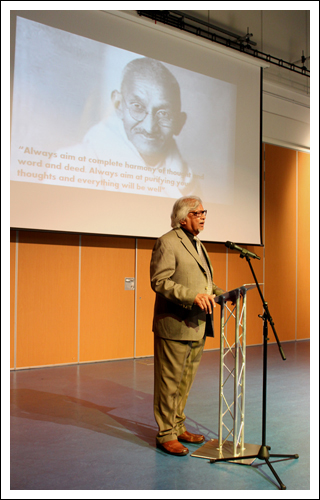
His belief that all people – Hindus and Muslims alike – are equal – ultimately costing him his life as he was assassinated in 1948 by a Hindu fanatic. His example of non-violent protest is still revered around the world today.
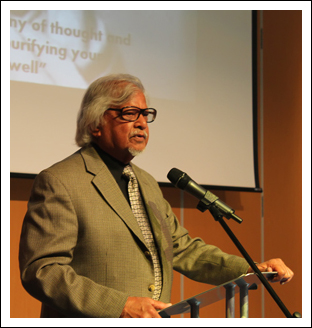
We were fortunate enough to have Gandhi’s grandson, Arun Gandhi here with us at Craigroyston to tell us about the lessons we can all learn from his grandfather.
Arun shared with our young people the importance of peace and encouraged each of us to “be the change you wish to see in the world”.
Arun was also able to meet with our Senior Prefect Team for an informal question and answer session. A number of pupils from our cluster primary schools were also able to attend.
“Learning to deal with anger is a very important thing”
That anger is not a bad thing but it is a thing we should be ashamed of if we abuse it. Arun explains how he saw this through his own eyes when he grew up in South Africa when there appeared to be a lot of hate around and he found himself, trying to stand up for his own rights. The first lesson he was taught by his grandfather was that anger was like electricity; it is just as useful and powerful if we use it intelligently, but it can be just as deadly and destructive if we abuse it. Just as we channel electrical energy and bring it into our lives and use it for the good of humanity, we must learn to channel anger in the same way so that we can use that energy for the good of humanity rather than abuse it and cause death and destruction.
When Arun was young, his grandfather suggested he keep an anger journal. A journal used not to pour anger out into, but a journal to write in to in a special way with the intention of finding a solution to the problem that the anger was based on and then committing himself to finding that solution.
Arun examined his actions every day and began to become aware of both physical and passive violence and learnt that once you aware of it then you can do something to change it. Passive violence fuels the fire of physical violence and since we are primarily the cause of passive violence, we have to cut off that fuel supply if we want peace in the world. If we do not change our attitudes, our relationships, our behaviour, we will never be able to create peace in the world. Peace has to begin with ourselves, if we cannot create peace within ourselves, we are not going to be able to create peace in the world.
His final words to us was from a story of old that his grandfather used to tell him, a story which occurred between an ancient king and an old sage and how a grain of wheat resolved the king’s attitude towards peace forever more. The king had asked everyone in his kingdom about the meaning of peace. When the sage was asked, he gave the king a grain of wheat. The king didn’t want to show any ignorance and kept this grain of wheat in a little gold box. A few days later, the king asked the sage to explain. If this grain of wheat were to be kept in a box then nothing will happen and it will eventually rot and perish, that would be the end of it. If that grain of wheat were allowed to interact with all the elements of the world, and you were to plant it outside in the soil, then it would sprout and grow and very soon you will have a kingdom full of wheat. That is the meaning of peace. If we have found peace and we keep that peace locked up in our hearts for our own pleasure, then it will rot and perish with us. If we let it interact with all of the elements of the world it will sprout and grow, and we will have our world of peace.


 Craigroyston Community High School